
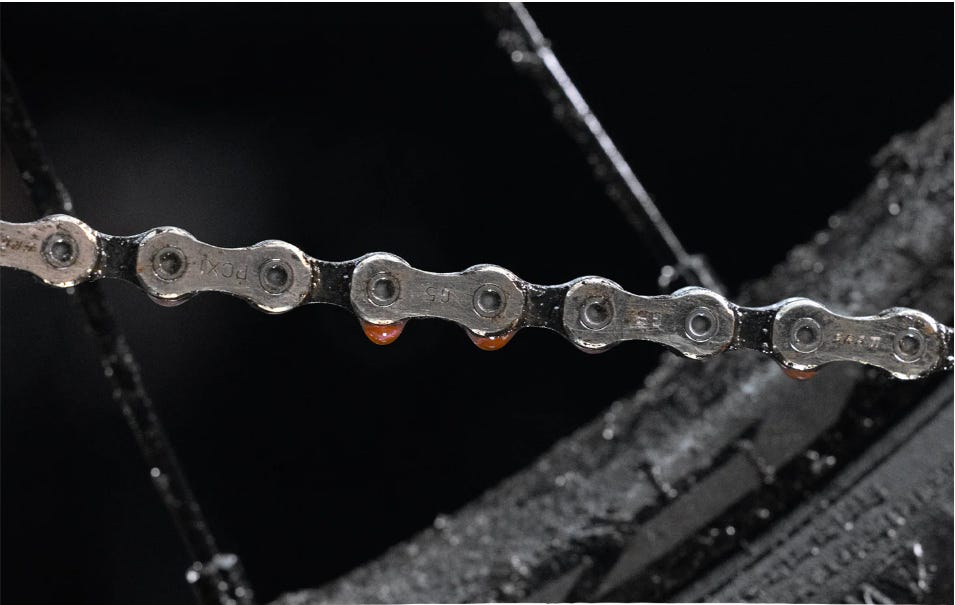
If you spend enough time in the cycling world, you’ll eventually run into the “wax cult.” You’ll see them in their garages, hovering over slow cookers like Walter White, claiming their drivetrain is cleaner than a surgical suite.
If you’re still using traditional drip lube, you’re likely wondering: Is the supposed performance gain worth the hassle of a Crock-Pot and a box of paraffin? Let’s break down the facts, the friction, and the filthy truth.
The “Mess” Paradox
The biggest barrier to entry for chain waxing is the initial setup. To do it right, you have to completely strip the factory grease off a new chain using mineral spirits and ultrasonic cleaners or aggressive degreasing baths. It is, undeniably, a chore.
However, once that first deep clean is done, the “mess” actually disappears.
No “Tattoo”: Say goodbye to the dreaded “rookie mark” on your right calf.
Touch-Friendly: You can drop your chain or change a flat without looking like you just performed an oil change on a diesel truck.
Tool Longevity: Your cassette and chainrings won’t accumulate the “black grinding paste” (lube mixed with road grit) that eats through expensive components.
The Benefits: Why the Pros (and Nerds) Do It
The move toward wax isn’t just about keeping your hands clean; it’s about physics and finance.
Reduced Friction: Independent testing (like those from Zero Friction Cycling) consistently shows that high-quality wax treatments offer the lowest friction of any lubricant. We’re talking a savings of 3–8 watts depending on your previous setup.
Component Life: Because wax is solid at room temperature, it doesn’t “suck in” road grit. Sand and dirt simply bounce off. This can double or even triple the lifespan of your chain and cassette.
The “Silent” Ride: A well-waxed chain provides a dampened, buttery-smooth mechanical feel that drip lubes struggle to match.
The Drawbacks: The Reality Check
It isn’t all marginal gains and sunshine. There are distinct reasons why wax might not be for you:
Water is the Enemy: Wax is excellent at shedding dry dirt, but it can be stripped away quickly in a heavy downpour. If you ride in the rain, you have to dry the chain immediately to prevent flash rusting.
The Re-wax Interval: You’ll typically need to re-dip every 200–300 miles. This means taking the chain off the bike (hello, master link pliers) and melting the wax again.
The Sound of Silence (Ending): When a waxed chain goes dry, it doesn’t just get slightly loud—it squeaks with a vengeance.
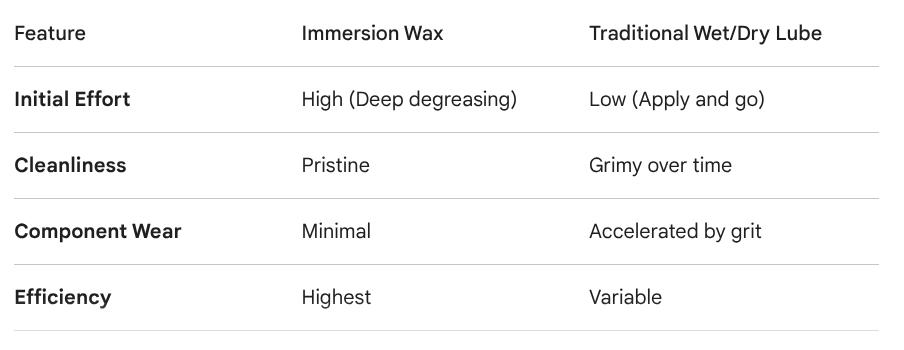
Comparison: Wax vs. Traditional Lube
The Recommendation
You should wax your chain if:
You do your own bike maintenance and enjoy the process.
You ride a high-end drivetrain where cassettes cost $200+.
You hate the “black mess” on your bike and in your car.
Stick to drip lube if:
You are a “commute in all weather” rider.
The idea of owning a dedicated slow cooker for your bike parts sounds insane.
You prefer a 30-second maintenance routine over a 30-minute one.
Next Steps for the Curious
If you want the benefits without the Crock-Pot, look into drip-on wax emulsions (like CeramicSpeed UFO or SILCA Super Secret). They require the same intensive initial cleaning, but they allow you to top off the wax between deep cleans just like a regular lube.
Easier Wax Technique
Silca Wax System w/Strip Chip
To purchase the Silca Wax System, you can use my Amazon Affiliate Link to help me out. Its an initial investment but this is by far the easiest way to wax the chain and save watts and you will love the smoothness and cleanliness of your drivetrain.
Silca Wax System $112.99
Silca StripChip $26.99
Silca SuperSecret 2oz bottle $16.00
The Verdict: It’s worth the mess once to never have a messy drivetrain again.
Comment Submitted
Thanks! Your comment is awaiting moderation and will appear shortly.