
There are two types of cyclists: those who master preventative maintenance, and those who end up stranded on the side of the road waiting for a rescue ride.
Bicycles are remarkably efficient machines, but they are completely exposed to the elements. Road grit, rain, mud, and sports drink spills act like an abrasive grinding paste on your moving parts. If you ignore your bike until it starts making horrible noises, you aren’t just looking at an annoying ride—you’re looking at a massive repair bill.
When you let a chain wear out completely, it stretches and destroys the teeth on your cassette and chainrings. What could have been a quick chain replacement suddenly mutates into a total drivetrain overhaul.
To keep your bike shifting crisply and rolling safely, you don’t need a degree in mechanical engineering. You just need to follow this simple, two-tiered maintenance checklist.
The 100-Mile Check: The Quick Routine
Think of the 100-mile mark as your weekly or bi-weekly baseline. This routine takes less than ten minutes and focuses on the high-friction components that actively keep your bike moving and stopping.
1. Wipe and Re-Lube the Chain
The Action: You don’t need to completely remove the chain. Grab a clean shop rag, wrap it around the chain, and pedal backward to wipe away the surface grit and black sludge. Apply a single drop of high-quality bicycle lubricant to each individual roller. Let it sit for five minutes, then take a fresh rag and vigorously wipe away all the excess surface lube.
Why it matters: Wet lube attracts dirt like a magnet. The lubrication needs to be inside the rollers, not on the outside plates.
2. Inspect the Brake Pads
The Action: Look closely down into your brake calipers. For disc brakes, ensure there is at least 1mm of braking material left on the metal backing plate. For rim brakes, check that the grit-clearing grooves in the rubber pads are still visible and haven’t worn flat.
Why it matters: Running brake pads down to the bare metal will ruin your expensive disc rotors or rim sidewalls instantly, turning a cheap pad swap into an emergency replacement.
3. Wipe the Suspension Stanchions & Tires
The Action: If you ride a gravel bike or mountain bike with suspension, wipe the dust off the shiny fork legs. Do a quick spin of your tires to look for embedded flint, glass, or wire before they work their way through the casing.
The 1,000-Mile Check: The Deep Dive
The 1,000-mile mark is your seasonal or bi-annual deep dive. This is where we measure wear precisely and service the hidden areas where grit hides.
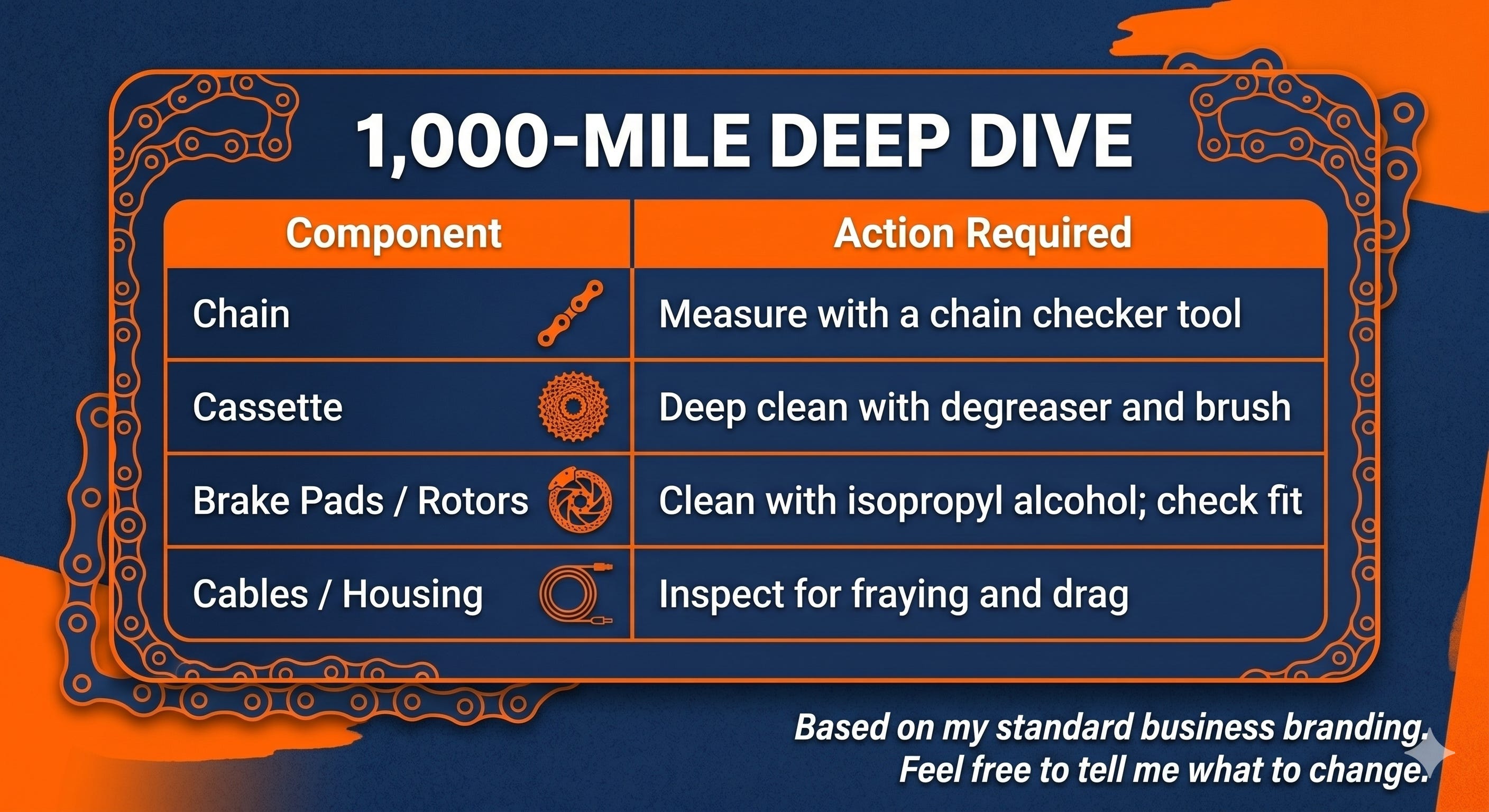
1. Measure Chain Wear (The Most Crucial Step)
The Action: Drop a mechanical chain checker tool into your chain links.
If the tool reads 0.5% wear, it is time to replace the chain.
If it reads 0.75% or higher, your chain is severely stretched and has likely started wearing down the teeth of your cassette.
Why it matters: A chain stretches because the internal pins wear away. Replacing a chain at 0.5% wear saves your cassette and chainrings, allowing you to get three or four chains out of a single drivetrain.
2. Scrape the Cassette “Gunk”
The Action: Remove the rear wheel. Use a dedicated cassette brush or an old toothbrush soaked in biodegradable degreaser to scrub between the gears. Floss between the cogs with a clean rag to remove the stubborn rings of grease and dirt.
Why it matters: Built-up sludge between your cogs prevents the chain from seating fully, causing ghost-shifting and sloppy gear changes.
3. Deep Clean the Braking System
The Action: Spray your disc rotors or rim braking tracks with isopropyl alcohol and wipe them with a pristine paper towel. Take your brake pads out, inspect them for uneven wear, and lightly scuff the surface with fine-grit sandpaper to remove any slick, glazed buildup.
Preventative Peace of Mind
Taking care of your bike shouldn’t feel like a chore. Spending ten minutes every 100 miles to keep your drivetrain clean completely alters the longevity of your components. You’ll shift smoother, ride quieter, and save hundreds of dollars a year at the bike shop.
Do you track your mileage for maintenance, or do you just wait for your bike to start squeaking? Let me know your routine in the comments below, and come to https://weeecycle.net for service of your bike.
Comment Submitted
Thanks! Your comment is awaiting moderation and will appear shortly.